Welcome to ShootingRests.net
Learn Here TECH 301.714.0008
|
|
|
 |
|
|

When your FIRST shot has to be your LAST...
Advanced
Shooting Target TECHNOLOGY for Shooting Ranges and Target Practice. The
knowledge and technical shooting target data that we will provide to
you has been tested and proven in real-world tactical SWAT operations,
world sniper competitions, including the hunter/marksmen..
Used by Law Enforcement Agencies, Military Detachments and EXPERT Shooters Worldwide!
OPERATIONAL TARGET TECHNOLOGY WITH ADVANCED TECHNICAL ACCURACY FORMULA!
FEATURES:
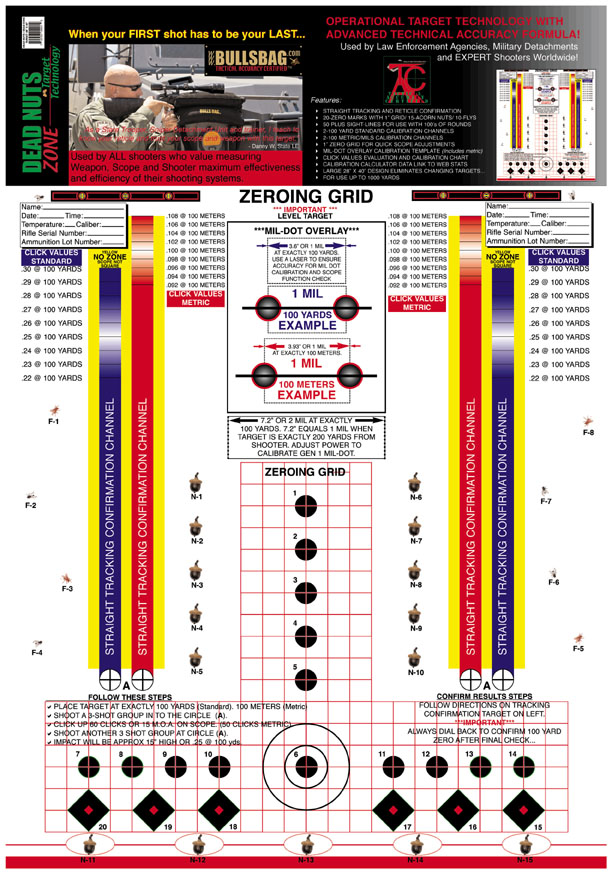
- STRAIGHT TRACKING AND RETICLE CONFIRMATION
- 20-ZERO MARKS WITH 1” GRID/ 15-ACORN NUTS/ 10-FLIES
- 50 PLUS SIGHT-LINES FOR USE WITH 100’s OF ROUNDS
- 2-100 YARD STANDARD CALIBRATION CHANNELS
- 2-100 METRIC/MILS CALIBRATION CHANNELS
- 1” ZERO GRID FOR QUICK SCOPE ADJUSTMENTS
- MIL-DOT OVERLAY CALIBRATION TEMPLATE (Includes metric)
- CLICK VALUES EVALUATION AND CALIBRATION CHART
- CALIBRATION CALCULATOR DATA LINK TO WEB STATS
- LARGE 28” X 40” DESIGN ELIMINATES CHANGING TARGETS...
- FOR USE UP TO 1000 YARDS
- CALCULATOR JBM Ballistics >>>Trajectory click here >>>
Our goal at ShootingRests/NET and the BRAINS OF SPECIALTY SHOOTING (B.O.S.S.) shooting target is to apply the science of ballistic fingerprinting and achieve the best possible accuracy from your rifle. DEAD Nuts/DEAD
ZONE Shooting Target-TECHNOLOGY “System” will make you vastly more
proficient during your limited range time with use of our rifle target.
The Operational Target for shooting is the only known diagnostic check
for the operational rifle and can be used to quantify the claims of a
new rifle system with use of our shooting range target. Shooters may
spend thousands of dollars on a precision rifle system; we will prove it
functions consistently and correctly with target practice!
The
knowledge and technical data that we will provide to you has been
tested and proven in real-world tactical SWAT operations, training
scenarios, and in national/world sniper competitions.
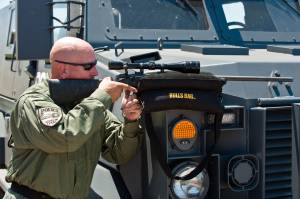 
Take the guesswork out of your long-range shooting with a proven process in a shooting target...
 Dan Weave is a 15 year counter-sniper with the Maryland State Police and developer of B.O.S.S. Accuracy Shooting Target-TECHNOLOGY “System.”
Most shooters are frustrated with the limited shooting range time,
access to long-distance shooting ranges and cost of ammunition.
Furthermore, once at a
shooting range, we find ourselves being limited to a known distance in
increments of 100 yards. Any long-range hunter and shooter knows this
practice lacks practical application once in the field.
To compound the problem, once we do our sighting and gathering of
ballistic data on our weapons, we may travel to different geographical
locations for the hunt or target practice. You could expect to have
extreme temperature and elevation changes (density altitude) that will
affect the pin-point accuracy impacts that you desire. For the most part
there will be enough shooter error in your mechanics and wind reading
to cause a miss at long-range. If you are the type of shooter that
believes nothing is ever close enough, we use mathematics and a proven diagnostic process to identify each rifle’s: idiosyncrasies. Dan Weave is a 15 year counter-sniper with the Maryland State Police and developer of B.O.S.S. Accuracy Shooting Target-TECHNOLOGY “System.”
Most shooters are frustrated with the limited shooting range time,
access to long-distance shooting ranges and cost of ammunition.
Furthermore, once at a
shooting range, we find ourselves being limited to a known distance in
increments of 100 yards. Any long-range hunter and shooter knows this
practice lacks practical application once in the field.
To compound the problem, once we do our sighting and gathering of
ballistic data on our weapons, we may travel to different geographical
locations for the hunt or target practice. You could expect to have
extreme temperature and elevation changes (density altitude) that will
affect the pin-point accuracy impacts that you desire. For the most part
there will be enough shooter error in your mechanics and wind reading
to cause a miss at long-range. If you are the type of shooter that
believes nothing is ever close enough, we use mathematics and a proven diagnostic process to identify each rifle’s: idiosyncrasies.
 WE HAVE THAT SHOOTING TARGET TECHNOLOGY HERE! WE HAVE THAT SHOOTING TARGET TECHNOLOGY HERE!
There
is rarely anything more disappointing to a shooter than identifying a
problem with a rifle system after a full day of gathering ballistic data
at the shooting range or especially during a hunt.
You need to know what makes this "DEAD Nuts/DEAD ZONE” calibration shooting targets valuable.
You
must understand that all rifles and their components have acceptable
tolerances in the machining process. Scopes have erector springs,
reticles and tolerances within the bullet drop compensating turrets.
Rifle barrels are machined, chambered and threaded. Rifle receivers are
cut from steel blanks threaded and tapped for scope mounts. Then you
have all the mounting option hardware with their acceptable machining
tolerances. Combining all of these components can produce a system that is out of square or lacks concentricity.
IMPORTANT...
Example: Your reticle may appear level but an acceptable tolerance for the manufacturer is 3 degrees.
This error is magnified exponentially by the shooting range to the
target. This is most noticeable at long-range shots while shooting
targets. However, many shooters dismiss this as wind deflection or
external ballistic factors. Many rifles have a straight tracking issue,
the ability of the reticle to adjust directly at a 90 degree angle, as
identified in the two vertical straight tracking channels of the
shooting target.
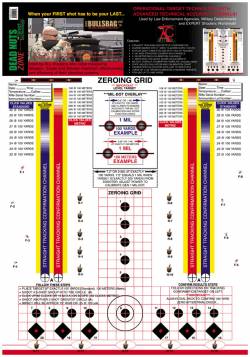 The shooting target measures 28” x 40” and is made of high quality cover weight stock.
The target must be mounted level at exactly 100 yards. This is
important as you will be gathering your true click value on our shooting
targets. “True click value” is something most shooters accept as determined by the scope manufacturer. As you will experience, most scopes have “strong” or “weak” clicks
due to tolerances within the scope. This information entered into your
data book will make for precise “dope” corrections for your
ever-changing shooting range conditions. The shooting target measures 28” x 40” and is made of high quality cover weight stock.
The target must be mounted level at exactly 100 yards. This is
important as you will be gathering your true click value on our shooting
targets. “True click value” is something most shooters accept as determined by the scope manufacturer. As you will experience, most scopes have “strong” or “weak” clicks
due to tolerances within the scope. This information entered into your
data book will make for precise “dope” corrections for your
ever-changing shooting range conditions.
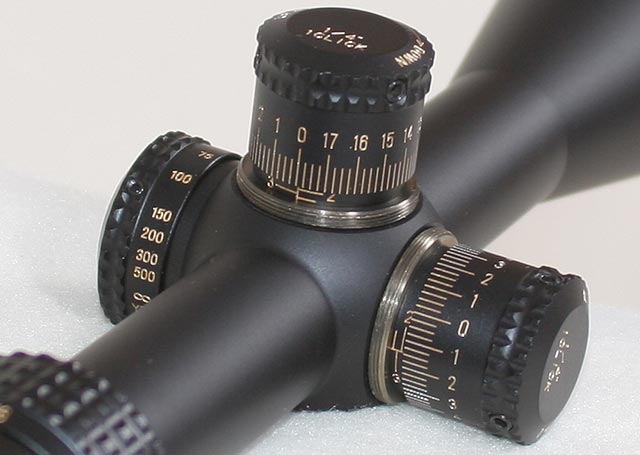
For example, let us
suppose your ¼ MOA scope (one click moves a bullet impact .25” (smoa) @
100 yards) is truly a .28 moa click. This 3/100 of an inch difference at
100 yards magnifies itself to a 10.8 inch difference just in scope
tolerance with 15 MOA of elevation placed on the scope for a 600 yard
target. Match
your “true click value” to the rifle’s ballistic drop table and you
have exact corrective adjustments for all shooting ranges.
Furthermore, you can calibrate your power sensitive Mil-Dot reticle
by aligning one or two Mil-Dots onto the Mil-Dot overlay. We even
helped duplex reticle shooters determine which points on their duplex
reticles to use for ranges estimation and variable wind hold-off. This
is especially useful as an aiming point on the reticle when dealing with
inconsistent, variable wind speeds while target practice or a sudden
lull in the wind.
HOW TO USE...
- The
shooting should start on the 1 inch zeroing circles and grids. Once
sub-minute of angle groups are in a dot the shooter may transition to a
straight tracking shooting target channel.
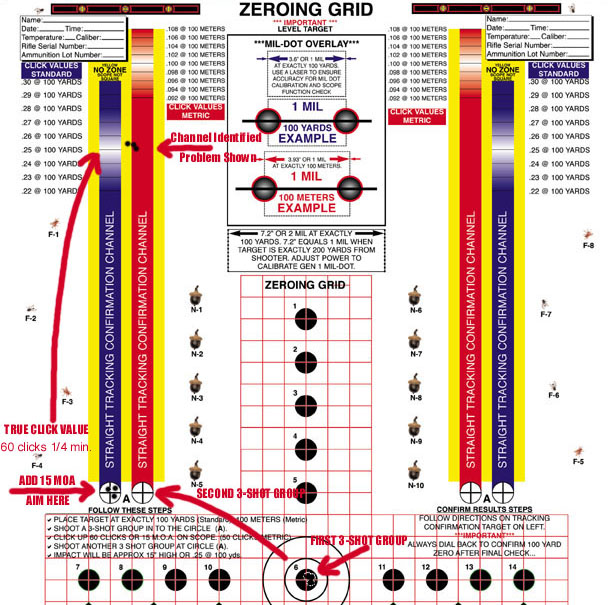
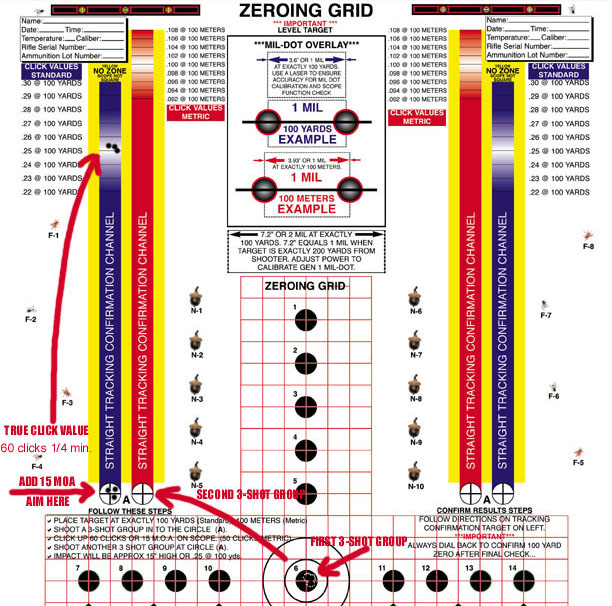 - Fire a 3 shot group into the circle at the bottom of the shooting targets left tracking channel.
 - Come
up 15 moa (60 clicks for ¼ moa scopes) on your elevation turret for the
shooting targets second group. This simulates a long-range elevation
correction; approximately 600 yards of elevation for a .30 caliber
projectile traveling at 2600 fps.
- Continue
to aim at the same circle at the bottom of the first tracking channel
rifle target. The new group impacts will be approximately 15” high. The
top group impact shooting target will also tell you the true click
value as indicated on the straight tracking channel target practice
exercise.
- If
your second group is unusually low on the shooting target, you may be
out of usable clicks of elevation. A forward cant scope base will fix
this. Years ago we even added some shims under the rear of the scope or
lapped the bottom of the front ring.
- If
the group impacts outside of the shooting targets channel a problem has
been identified. These are easily corrected by loosening the rings and
giving a slight rotation of the scope in the opposite direction of the
group.
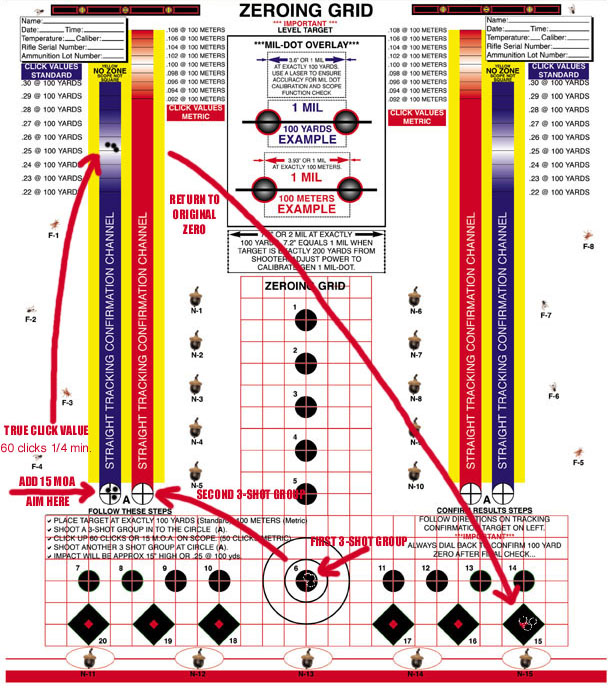
- In
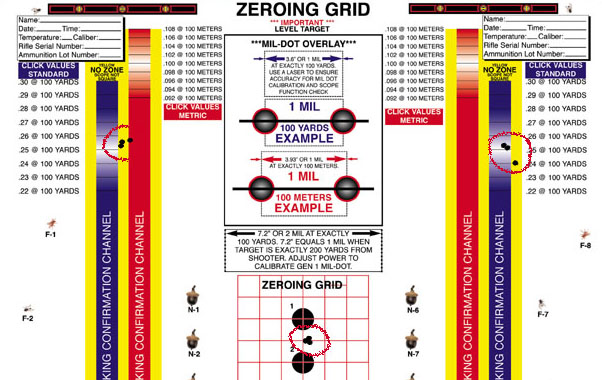
the shooting target pictured below, notice the group on the left as
compared to the group on the right. The shooter nearly brought the group
back to true vertical tracking with an approximately 1/32” left rotation
on his first attempt. A tighter group will produce more accurate data.
You will need to make slight corrections to your 100 yard zero each
time the scope tube is rotated.
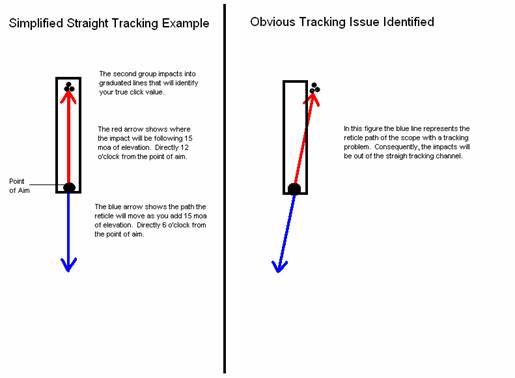
You
will notice the bold horizontal lines in the top of the straight
tracking channel shooting target illustration , these will identify the
true click value at the shooting range. This will give you an overall
average of your scopes elevation click value.
NOTE:
You
could also fire into the rifle target groups after every 3 or 5 minutes
of elevation and watch as the groups climb up through the shooting
targets tracking channel until finally reaching 15 moa of elevation. It
never hurts to continue with another couple minutes of elevation and a
follow-up group to ensure you are not at the end of your usable clicks
of elevation as mentioned earlier. This can also be verified by having a
shooting partner turn up some elevation on turret as you are solidly
locked in on the down-range shooting target. The reticle will move down
as elevation is added.
IMPORTANT:
There are six black diamonds on the bottom of the shooting target.
It would be wise to engage these shooting targets after putting the 15
minutes of angle (60 clicks) of elevation on your scope and then
returning to the original zero. This will confirm the ability of the
scope to return and hold its zero. Some shooters struggle with what they
deem a cold bore issue that may actually be a reticle settling issue.
Now that you have performed this diagnostic shooting range function,
check of your rifle system and corrected any problems, you’re ready for
the field application. It is not enough to assume your bullet will exit the barrel at the velocity claimed by the manufacturer.
For truly accurate data you must chronograph the projectile and average at least 10 shots.
Run a ballistic table matching the exact components and conditions you
are shooting in; correct sight height, temperature and ballistic
coefficient as examples. Use the following data as an example of
pre-hunt charting for 620 and 630 yard shots. The yardage increments you
choose on your ballistic chart can be based on a personal choice. In
the example below we have chosen 10 yard increments.
620 yards – bullet drop is 139 inches from your base zero
• You determined your true click value is .28” at 100 yards and 1.73” inches per click at 620
yards or .28 x 6.20 = 1.73 (6.20 representing units of 100 yard increments)
• Divide the drop (139”) by your true click value at 620 yards (1.73”)
139/1.73 = 80 clicks of elevation or 20 minutes of angle (80/4 = 20)

630 yards – bullet drop is 145 inches from your base zero
• You determined your true click value is .28” at 100 yards and 1.76” inches per click at 630
yards or .28 x 6.30 = 1.76 (6.30 representing units of 100 yard increments)
• Divide the drop (145”) by your true click value at 630 yards (1.76”)
145/1.76 = 82 clicks of elevation or 20.5 minutes of angle (82/4 = 20.5)
CALCULATOR JBM Ballistics >>>Trajectory click here >>>
Going
through the shooting targets exercise above will prove to be very
beneficial for your weapons system and can save you a lot of
aggravation, time and money. You can get further information on this system by calling the Bulls Bag Co. 717-294-6000
|
|
|
|


